Mountains & peaks
OreadsὈρειάδες
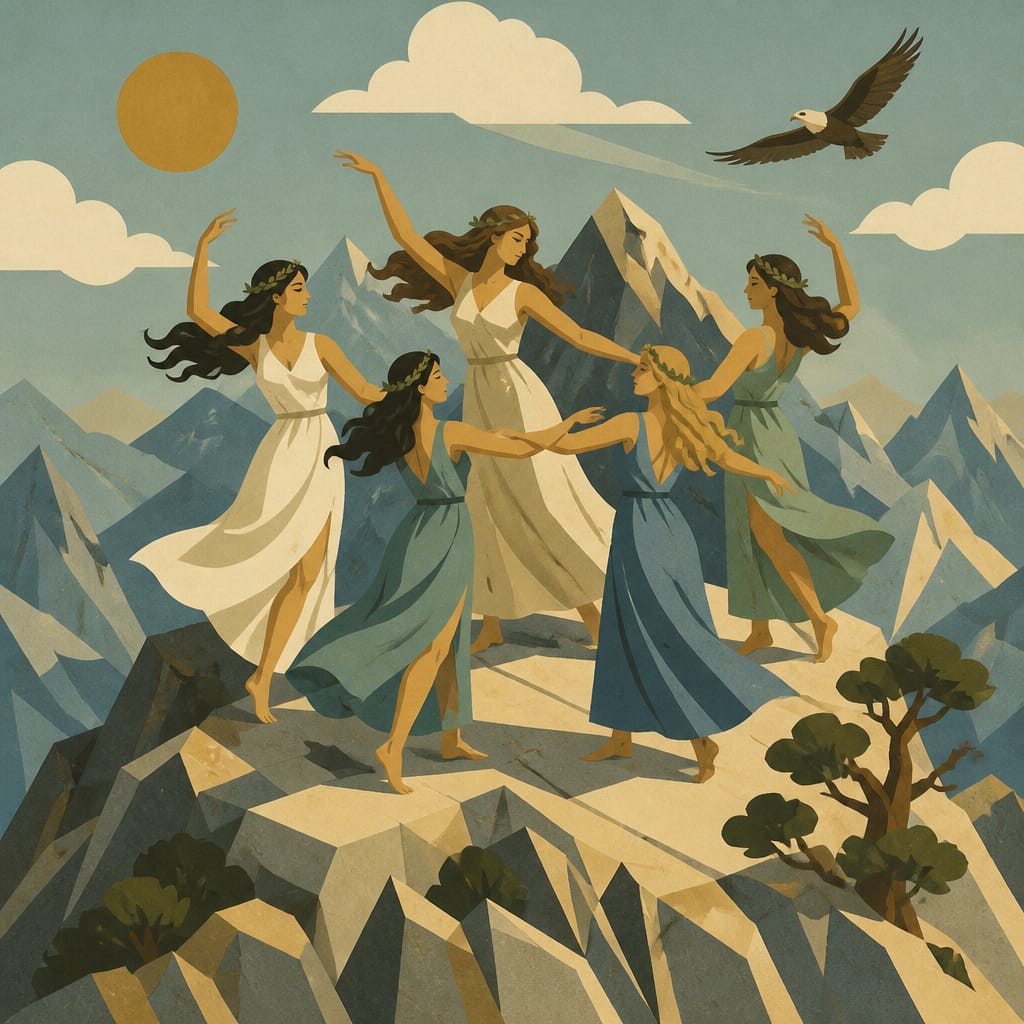
The mountain nymphs proper — spirits of the high places, of wind-scoured stone and eagle nests. They dance upon the summits where mortals dare not walk.
Mountains · Cliffs · Caves · High Places
Ὀρειάδες — those of the mountains
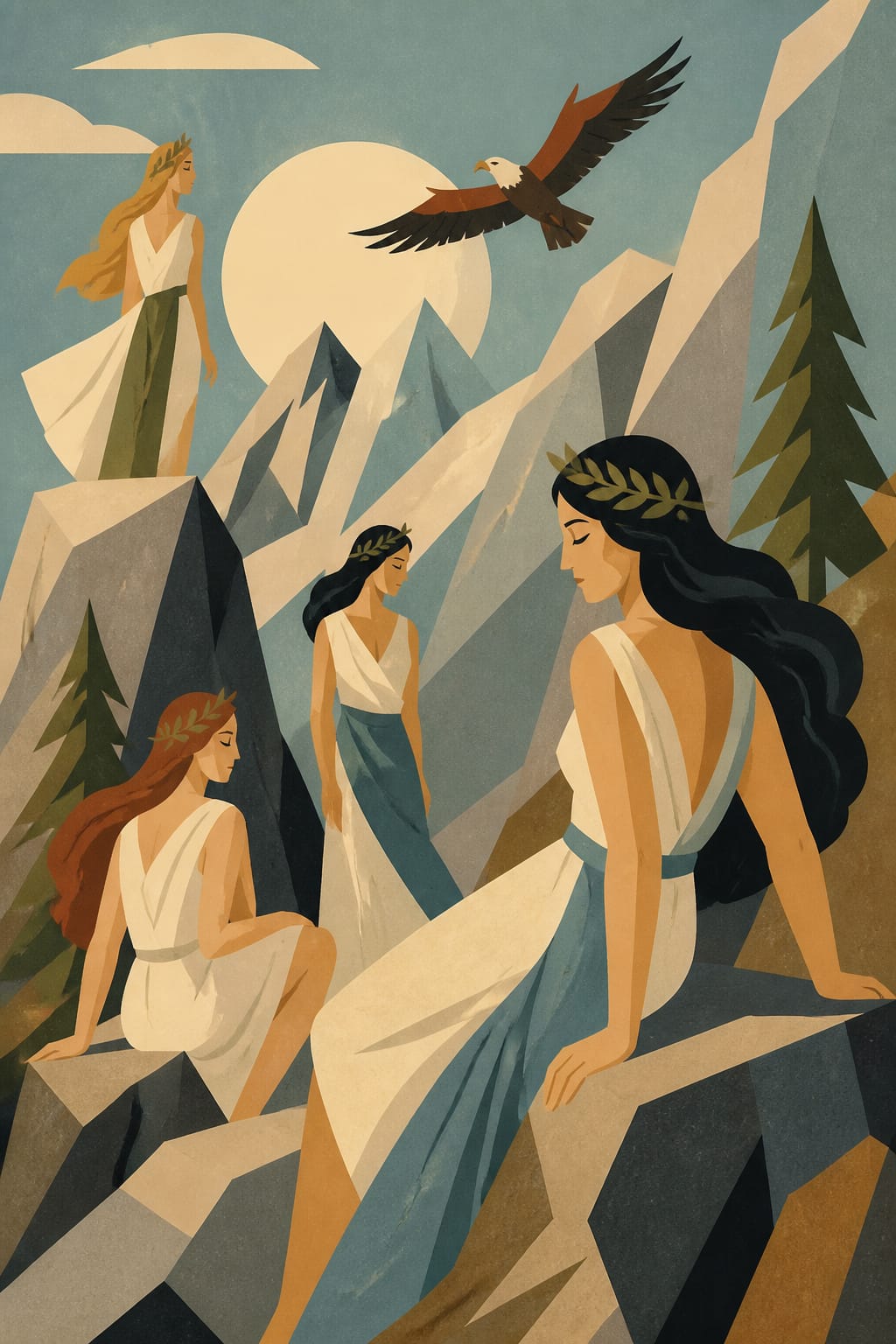
Daughters of stone and wind, the Oreads dwell where the air grows thin and eagles nest — guardians of the high places, witnesses to the ages.
The Oreads are the nymphs of mountains — spirits of the high places, of cliff and cavern, of the wind that howls through passes and the silence that settles upon snow-capped peaks. Their name derives from oros, the mountain, and it encompasses all who dwell where the earth reaches toward heaven: the Oreads of the open summit, the Kouretides of the secret cave, the Korykiai of the overhanging rock, the Napaias of the mountain glen.
In the ancient world, mountains were the abodes of gods — Olympus, Ida, Parnassos, Helikon — and the Oreads were their attendants, the lesser divinities who made the high places habitable for divine presence. They danced upon the crags where no mortal foot could follow, bathed in clouds, and spoke with voices like falling water or the rush of wind through stone. To the Hellenes, a mountain was not dead rock but a living being, crowned with divinity from base to summit.
The Oreads are the most solitary of the Nymphai, the most stoic and enduring. They do not flow like the Naiads, nor dance in company like the Dryads. They watch, they witness, they remember. An Oread may outlast empires, her stone face unchanged while civilisations rise and fall in the valleys below. To climb toward them in reverence, to leave an offering upon a cairn, to speak one's prayer into the echoing air — this is the ancient devotion to the mountain spirits, as old as the stone itself.
The Oreads are named by their dwelling-place — summit, cave, cliff, glen, hollow, and stone. Each kindred holds its own mystery, its own gods, and its own ancient law.
Mountains & peaks
The mountain nymphs proper — spirits of the high places, of wind-scoured stone and eagle nests. They dance upon the summits where mortals dare not walk.
Caves & grottoes
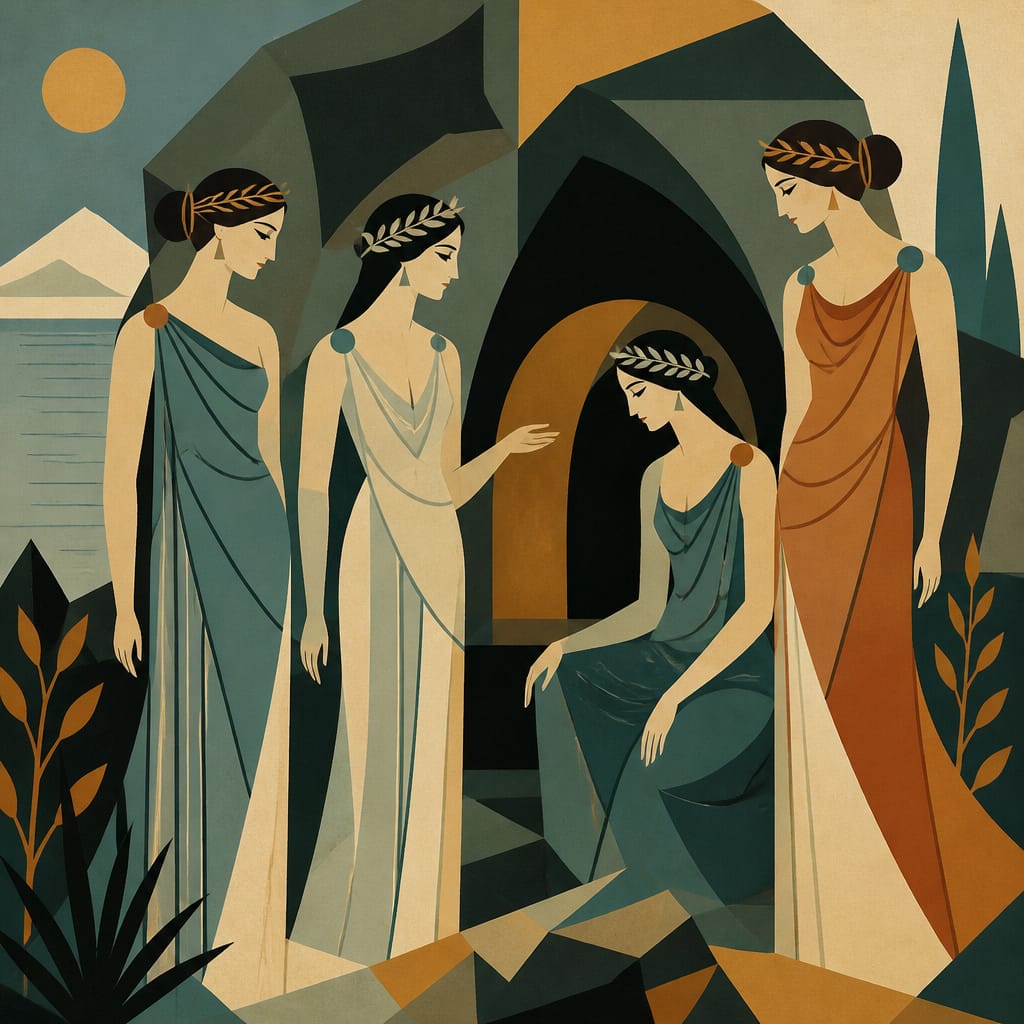
Nymphs of the hidden caves and grottoes, companions of the Kouretes. They guard the secret entrances to the underworld and the birth-chambers of gods.
Mountain caverns
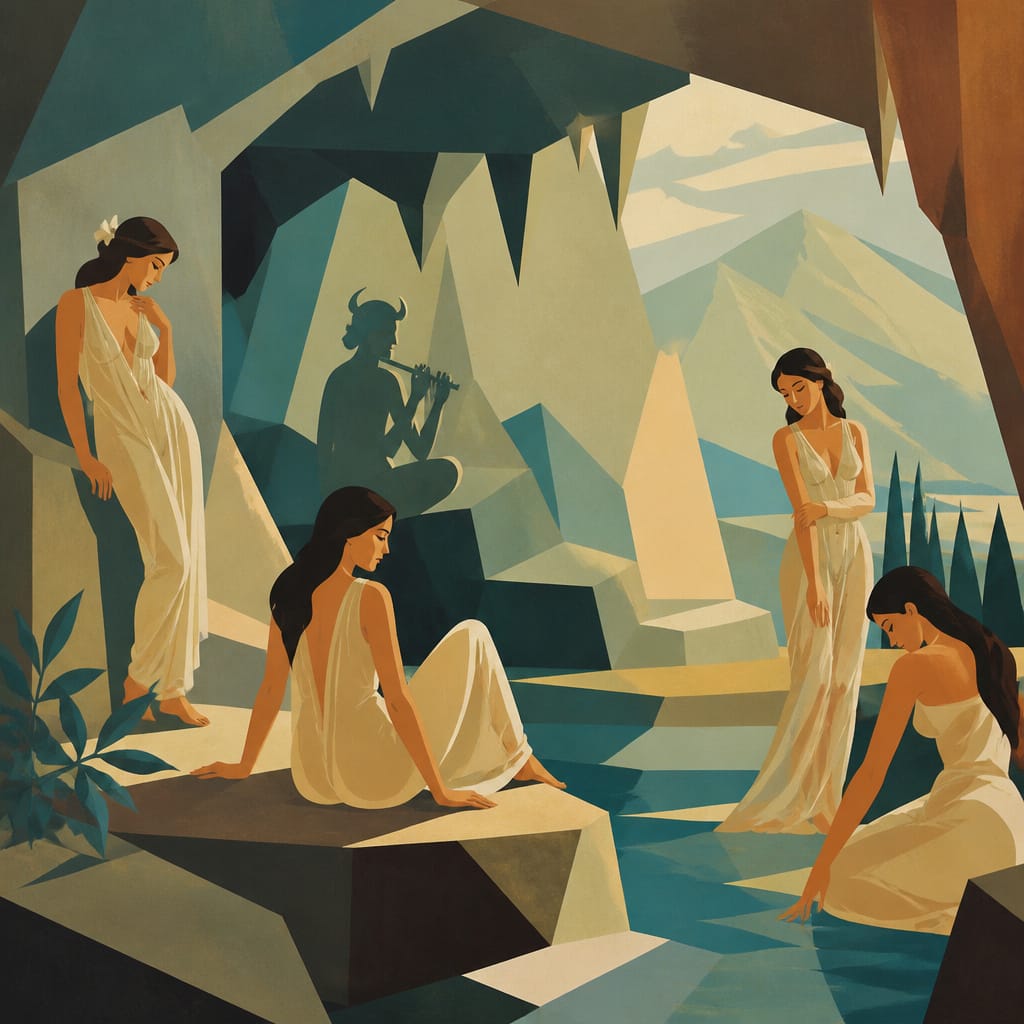
Spirits of the deep caverns and overhanging cliffs. The Korykian Cave on Mount Parnassos was their most famous dwelling, sacred to Pan and the Nymphai.
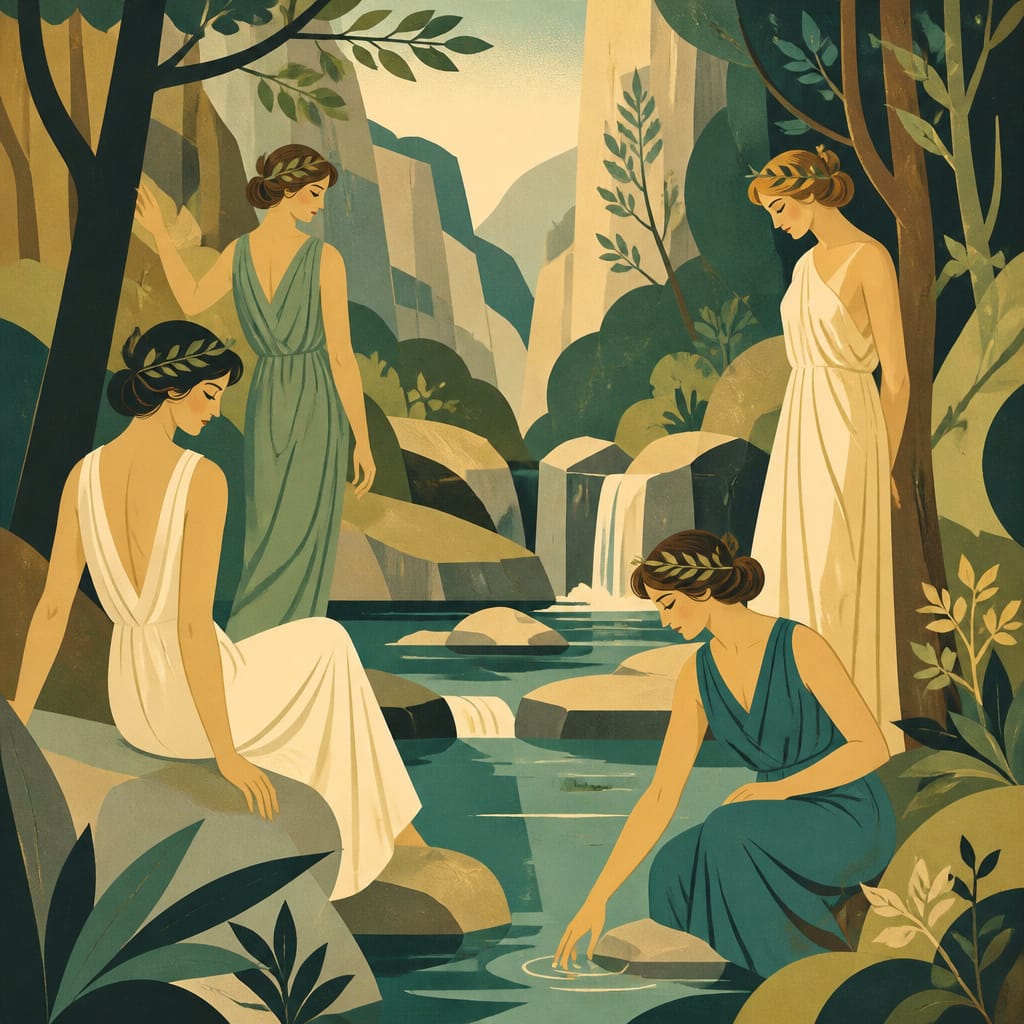
Mountain valleys & glens
Nymphs of the wooded mountain valleys and shaded glens — where cliff meets green, where the mountain opens its arms to welcome the stream.
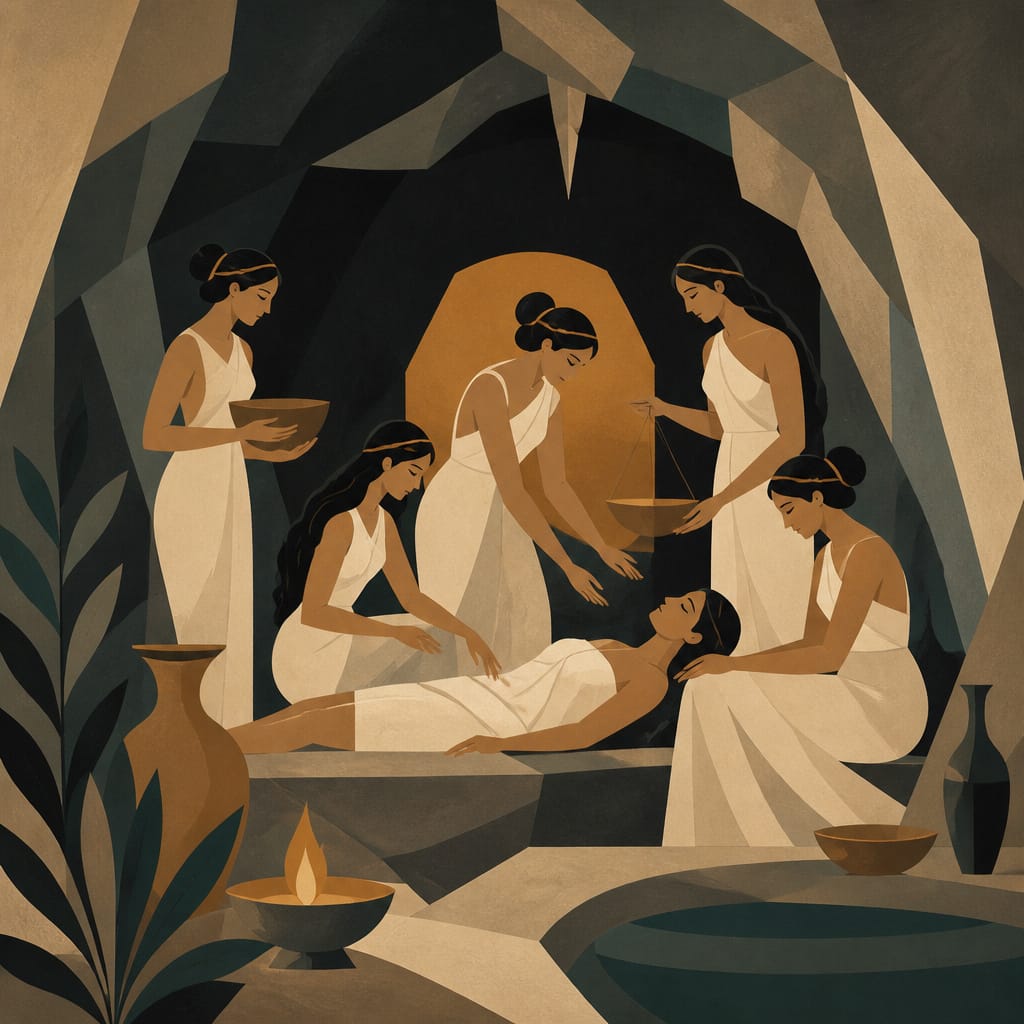
Caves & hollows
The cave-nymphs, dwellers in the hollowed rock. They are the midwives of mysteries, presiding over rites of initiation in the earth's dark womb.
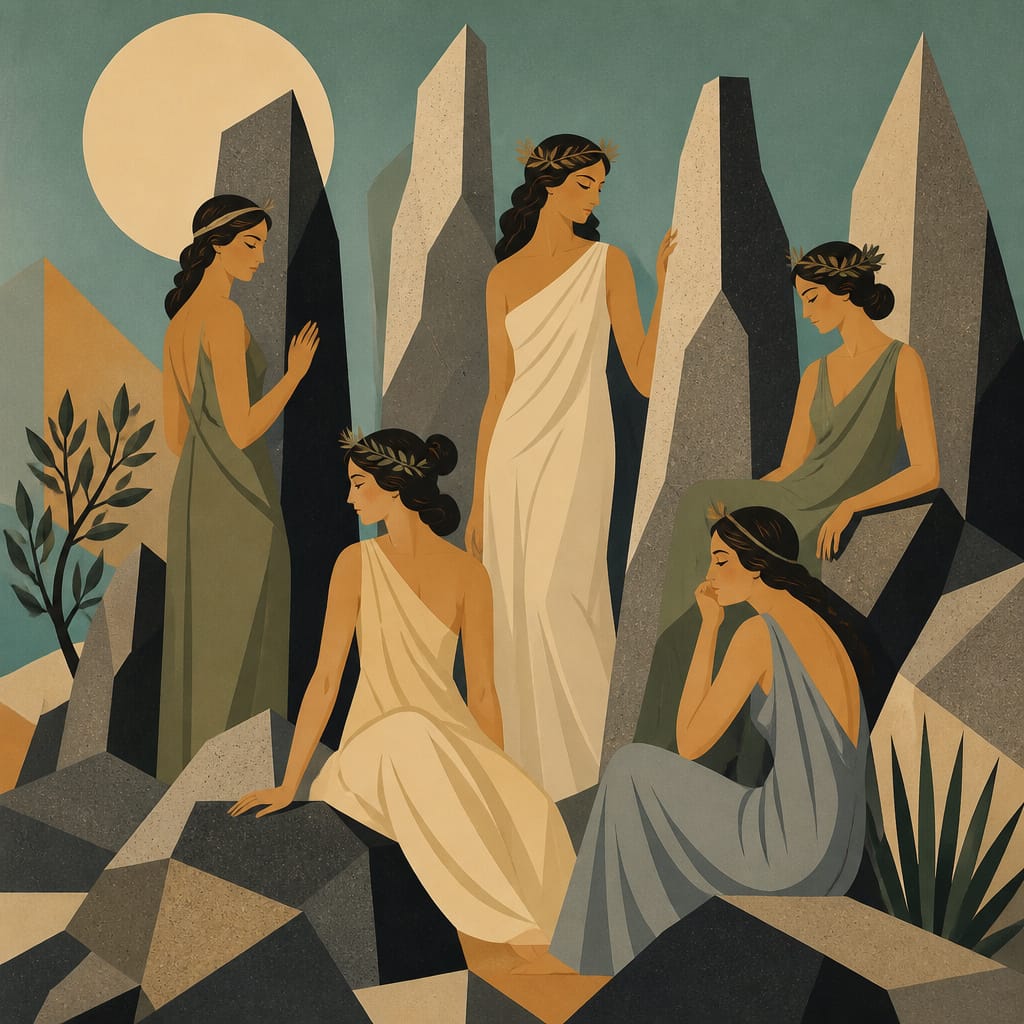
Stones & rocky places
Spirits of the standing stones and rocky outcrops — the oldest of the Oread kindred, born when the mountains themselves were young.
A chorus from the countless mountain spirits — each remembered by the peak she guarded, the cave she inhabited, or the echo she became.
EchoἨχώ
Mount Kithairon
The most famous Oread — cursed to repeat only the last words of others, she faded until only her voice remained, haunting the mountain passes forever.
HelikeἙλίκη
Mount Helikon
The nymph of Mount Helikon, companion of the Muses. Her mountain was sacred to Apollo and the home of poetic inspiration.
KorkyraΚόρκυρα
The island's mountains
An Oread of the high rocks; her name was given to the island of Korkyra (Corfu), where she was beloved by Poseidon.
PleiadesΠλειάδες
The seven peaks
Though best known as stars, the Pleiades were born as Oreads of the seven mountain peaks, transformed to escape the hunter Orion.
KylleneΚυλλήνη
Mount Kyllene
The nymph of Mount Kyllene in Arkadia, where Hermes was born in a secret cave. Her mountain was the birthplace of the messenger god.
TaygeteΤαϋγέτη
Mount Taygetos
One of the Pleiades and Oread of the great mountain that dominates Laconia. She was pursued by Zeus and transformed into a doe to escape him.
MaiaΜαῖα
Mount Kyllene
The eldest and loveliest of the Pleiades, Oread of the mountain cave where she bore Hermes to Zeus in secret.
ElektraἨλέκτρα
Mount Saos
A Pleiad Oread of Samothrace, mother of Dardanos and Iasion. Her mountain held the famous Mysteries of the Great Gods.
AlkyoneἈλκυόνη
The cliff-nest
A Pleiad Oread who, transformed into the halcyon kingfisher, nests upon the cliffs each winter when the sea is calm.
KelainoΚελαινώ
The dark peaks
The 'dark one' among the Pleiad Oreads — her mountain was shrouded in storm and shadow, her cave the dwelling of ill omens.
SteropeΣτερόπη
The lightning crag
The 'lightning' Pleiad, Oread of the storm-scorched peak. Her mountain drew the thunderbolts of Zeus.
MeropeΜερόπη
The hidden summit
The faintest star and the most hidden Oread — she married a mortal king and dimmed herself in shame, forever half-lost among the peaks.
KalypsoΚαλυψώ
The concealing mountain
Though often called a sea-nymph, her name means 'she who conceals' — she was also an Oread of the high hidden cave where she detained Odysseus.
AdrasteiaἈδράστεια
Mount Ida
A Kouretid nymph of the Cretan cave where she nursed the infant Zeus, hiding him from Kronos in the mountain's secret breast.
IdaἼδη
Mount Ida
The nymph of Mount Ida in Crete — with Adrasteia she tended the infant Zeus, feeding him honey and the milk of the sacred goat Amaltheia.
AmaltheiaἈμαλθεία
Mount Ida
The goat-nymph of the Cretan mountain cave, whose horn overflowed with nourishment for the young Zeus — the original cornucopia.
The classical offering to an Oread is given at the threshold between mortal and divine ground — the cairn, the cave mouth, the spring that flows from the rock.
The Oreads are patient but unforgiving. Their realm is not easily healed; a scar upon the mountain outlasts the hand that made it.
"Oreads, who dwell upon the wind-swept heights,
whose thrones are crag and cavern, whose breath is cloud —
daughters of stone and storm, who see all from above,
come, steadfast ones, with echoing, ancient heart,
and bless the one who climbs to meet your gaze."
After the Orphic Hymn to the Nymphs (No. 51)