For the Naiads
Invocation at the Spring
Bright-eyed daughters of Okeanos,
who tread the cool grottoes of the earth,
hear the sound of my voice at your water —
let your laughter rise in the ripple,
and let me drink as a guest at your hearth.
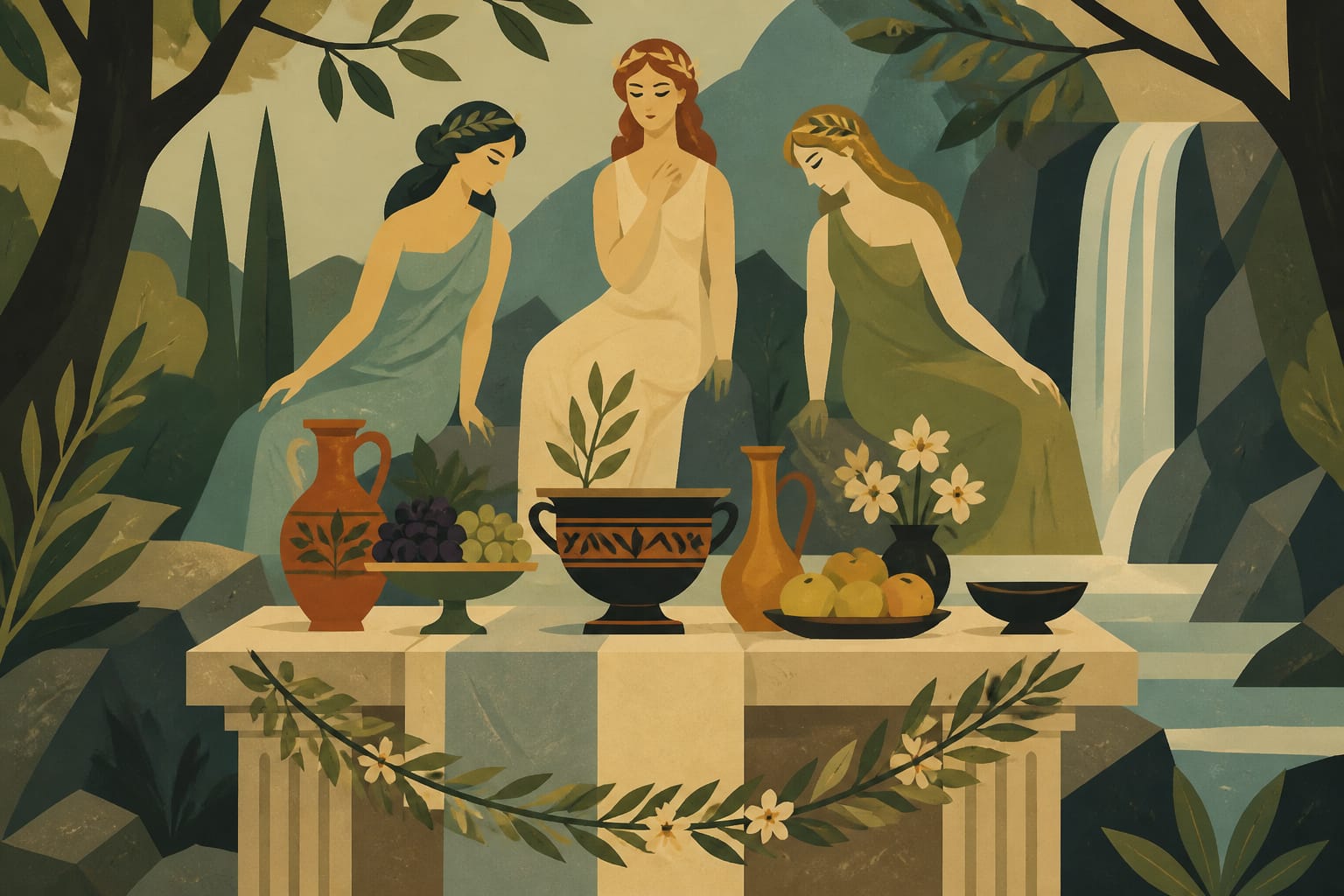
Voice · Breath · Listening
Ritual is the door. Relationship is the room. These hymns, prayers, and small daily practices are offered as ways of crossing the threshold — from speaking about the Nymphai to speaking with them.
The ancients did not pray silently. They spoke — and more often they sang. A hymn is a tuning fork: it carries breath, intention, and beauty into the air of a place, and invites the spirit there to lean a little closer. To sing for a Nymph is to share with her something that only living things can give: a voice.
Personal connection grows slowly, in the same way friendship does. It is built of small, repeated acts — a greeting at the spring, water poured for the tree at the corner, the same words whispered each morning until they begin to feel less like words and more like a hand laid upon an old door. Keep the door warm. The Nymph will answer in her own time.
One hymn for each of the great kindreds of the Nymphai — to be spoken aloud at the water's edge, beneath the boughs, or wherever her presence is felt.
For the Naiads
Bright-eyed daughters of Okeanos, who tread the cool grottoes of the earth, hear the sound of my voice at your water — let your laughter rise in the ripple, and let me drink as a guest at your hearth.
For the Nereids
Fifty sisters of the green-glass sea,
dancers upon the swelling tide,
hear me as the spray hears the wind —
carry my prayer to Nereus your father,
and keep me gentle upon your waters.
For the Dryads
Green-veiled keepers of the rooted ones,
who breathe within the long-bodied trees,
I lay this offering at the bole.
Let me walk softly beneath your boughs,
and let no axe rise in my hand.
For the Oreads
You who answer the shepherd's call,
who echo the cry of the soaring hawk —
high-stepping nymphs of the stony places,
look upon me as I climb,
and steady my foot upon the path.
For the Anthousai
Sun-warmed sisters of bloom and bee,
who wake the meadow with your breath,
crown me with the bright unbidden flowers,
and teach me the slow patience
of the seed that waits to open.
The most enduring devotions are not the longest. These four brief prayers can be folded into an ordinary day.
On Waking
"Nymphai of this place — of the water I will drink, of the trees that breathe near my window, of the stones beneath my feet — I greet you. Be near me this day."
Before Drinking Water
"From a spring I have not seen, by hands I do not know, this water has come. Naiads, daughters of the source — I drink with thanks."
On Entering a Wild Place
"I come as a guest. I bring no harm. Let the spirit of this grove know me, and let me leave it as I have found it."
Before Sleep
"Quiet Nymphai of the evening hush — keep the small lamp of my breath burning until morning, and visit my dreams with kindness."
Five small disciplines, none requiring more than a few minutes a day, that over time deepen the bond between devotee and Nymph.
01
Before any prayer, stand at the edge of a wild place for the length of three slow breaths. Speak only when the place has spoken first — in the rustle of a leaf, the lap of water, the call of a bird.
02
Keep a corner of the home for the Nymphai: a bowl of fresh water changed daily, a sprig of green from the season, a single flame. It need not be grand. It must be tended.
03
When you visit a particular spring, tree, or stone often, ask the spirit for her name. Do not invent one. Wait — sometimes for months — until a name comes unbidden in a dream, a coincidence, or the air.
04
Once in a season, travel on foot to a nearby water — a brook, a fountain, the sea. Carry the offering. Walk the last stretch in silence. The journey is half the prayer.
05
Anything taken from a wild place — a stone, a sprig, a feather — eventually wishes to go home. After a year and a day on the shrine, return it to a place of its kind with thanks.
"She will not always answer in words.
Sometimes the answer is a sudden hush among the leaves;
sometimes a kingfisher on the bough;
sometimes only the deepening of your own breath.
Learn to recognize all of these as her voice."
— From the Nymphikon